Bounce by Aaron Früh
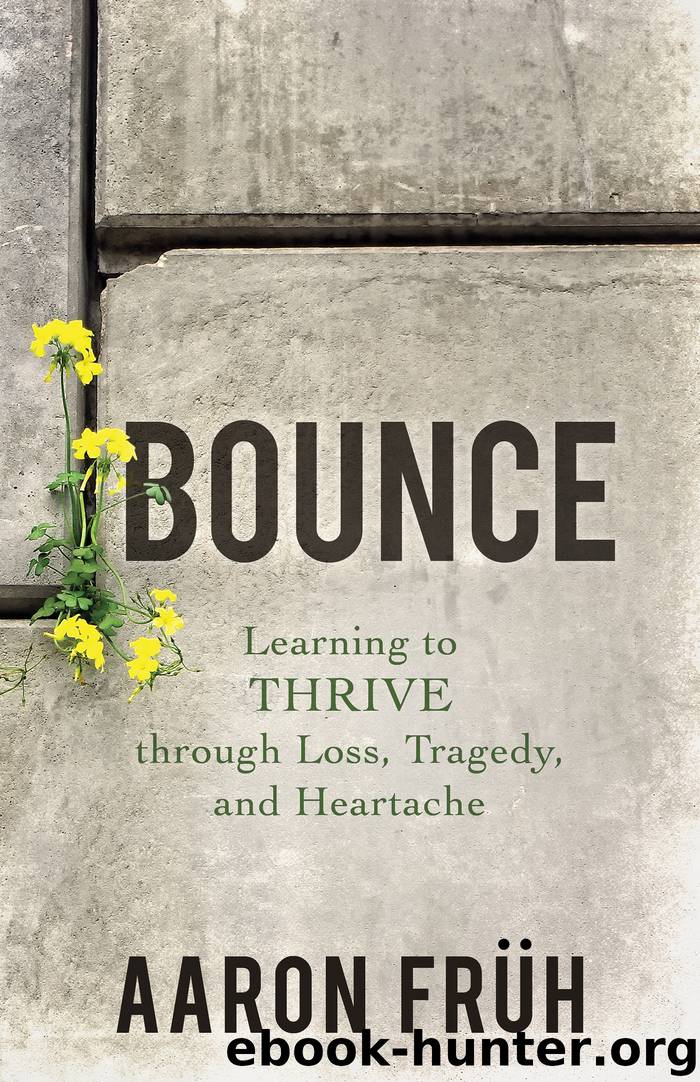
Author:Aaron Früh
Language: eng
Format: epub
Tags: Christian Living/Personal Growth;REL012070;REL012000;SEL000000
ISBN: 9781493406982
Publisher: Baker Publishing Group
Published: 2017-07-26T04:00:00+00:00
If You’re Indecisive You’ve Got Issues
One of the clearest definitions of indecisiveness in the Bible is found in James 1:5–8:
If any of you lacks wisdom, let him ask of God, who gives to all liberally and without reproach, and it will be given to him. But let him ask in faith, with no doubting, for he who doubts is like a wave of the sea driven and tossed by the wind. For let not that man suppose that he will receive anything from the Lord; he is a double-minded man, unstable in all his ways.
The word doubleminded, as it is applied in the Bible, comes from the Greek word dipsuchos. We discover the meaning of dipsuchos when we break it down: from di we get “twice” and from psuche we get “a soul.” To be doubleminded, then, simply means to have two minds or two souls that are in conflict with each other. It’s clear that indecisiveness is a matter of your soul: your mind, will, and emotions. In short, it’s a heart issue. If part of you trusts that God’s love is perfect and His wisdom is infallible even in your suffering, and the other part of you has lost all hope in God’s ability to restore your losses, you’ve got a vacillating heart. You’ve become “two-souled,” or doubleminded. James makes it clear that indecisiveness is a matter of the heart when he says, “Draw near to God and He will draw near to you. Cleanse your hands, you sinners; and purify your hearts, you double-minded” (4:8).
You see, indecisiveness is much deeper than an elementary weakness in your decision-making capabilities. Indecisiveness cannot be solved by reading a how-to book about becoming more resolute. James says that indecisiveness is caused by an impurity in your heart. In other words, indecisiveness is sin: “Cleanse your hands, you sinners; and purify your hearts, you double-minded.”
The Bible breaks sin down into three categories: sin, transgression, and iniquity. The psalmist David said, “I acknowledged my sin to You, and my iniquity I have not hidden. I said, ‘I will confess my transgressions to the LORD,’ and You forgave the iniquity of my sin” (Ps. 32:5).
First of all, David says, “I acknowledged my sin.” Anything that separates you from the glory of God is sin. Basically, sin is like an archer who misses his mark: it’s falling short of God’s standard of righteousness. Next, David says, “I will confess my transgressions to the LORD.” A transgression is a premeditated, repeated sin driven by willful disobedience. So when you miss the mark of God’s righteousness, you have sinned. When you continue in that same sin over and over again, the sin becomes a transgression.
Continuing to lay out the categories of sin, David concludes by saying, “And You forgave the iniquity of my sin.” An iniquity takes root in your life when sin gives birth to continued transgression. When that transgression is repeated long enough, it perverts and defiles your character—that’s iniquity. Iniquity affects your beliefs and attitudes to the point where you become so entrenched in unbelief that hope evaporates.
Download
This site does not store any files on its server. We only index and link to content provided by other sites. Please contact the content providers to delete copyright contents if any and email us, we'll remove relevant links or contents immediately.
The 5 Love Languages: The Secret to Love That Lasts by Gary Chapman(9794)
The Space Between by Michelle L. Teichman(6933)
Assassin’s Fate by Robin Hobb(6200)
Wiseguy by Nicholas Pileggi(5772)
Everything Happens for a Reason by Kate Bowler(4734)
Gerald's Game by Stephen King(4642)
Pillow Thoughts by Courtney Peppernell(4273)
A Simplified Life by Emily Ley(4159)
The Power of Positive Thinking by Norman Vincent Peale(4062)
Harry Potter and the Prisoner of Azkaban (Book 3) by J. K. Rowling(3357)
Resisting Happiness by Matthew Kelly(3337)
Girl, Wash Your Face by Rachel Hollis(3282)
Being Aware of Being Aware by Rupert Spira(3273)
The Secret Power of Speaking God's Word by Joyce Meyer(3186)
The Code Book by Simon Singh(3185)
More Language of Letting Go: 366 New Daily Meditations by Melody Beattie(3024)
Real Sex by Lauren F. Winner(3017)
Name Book, The: Over 10,000 Names--Their Meanings, Origins, and Spiritual Significance by Astoria Dorothy(2984)
The Holy Spirit by Billy Graham(2945)
